
Blog
What to Do if the IRS Questions or Audits Your Car Donation Deduction
The IRS reviews a car donation deduction by checking specific documents, not estimating guesswork. This guide shows exactly what to keep for each claimed-value tier, when a qualified appraisal is still required, and how to respond if an audit notice arrives.
An IRS notice questioning a vehicle donation deduction is rarely about bad faith. Most of the time it comes down to missing paperwork: a Form 1098-C that never got attached, a Form 8283 that wasn't filled out correctly, or a claimed value that doesn't match what the charity actually received for the car. Vehicle donations carry their own set of substantiation rules that differ from other noncash gifts, and knowing them before a letter arrives is the difference between a quick resolution and a disallowed deduction.
What the IRS Checks First on a Vehicle Donation
When the IRS questions a car donation deduction, it is almost always verifying three things: whether the recipient organization qualifies under Internal Revenue Code Section 170(c)%20edition:prelim)), whether you can produce the charity's written acknowledgment, and whether the claimed value is consistent with what the charity actually did with the vehicle.
Unlike most other noncash gifts, a donated vehicle isn't valued purely by what a buyer would pay for it on the open market. The deduction is usually tied to what the charity received when it sold the car, which is a narrower and more auditable number than a guidebook estimate. Our Form 8283 guide for car donations walks through how that form gets filled out correctly, which is worth reviewing before you respond to any notice.
Gather These Documents Before You Respond
Before drafting a response to any IRS inquiry, assemble a complete paper trail. The documents you need depend on the claimed value, but a thorough file should include:
- Form 1098-C or an equivalent contemporaneous written acknowledgment (CWA) from the charity, showing the sale date, gross sale proceeds, or the charity's certification of significant use, material improvement, or a below-market transfer to a needy individual.
- A complete, signed Form 8283 reporting the vehicle in Section A, including the vehicle identification number (VIN), as the IRS instructions for Form 8283 require.
- A qualified appraisal, if the charity certified an exception that lets you claim fair market value instead of sale proceeds.
- Photographs of the vehicle taken near the contribution date, along with title transfer records and any prior repair or purchase history.
Pro tip: Request the charity's acknowledgment in writing at the time of donation, not months later. Under IRS guidance on donor acknowledgments, the charity generally has 30 days after the sale (or 30 days after the contribution, if it certifies a qualifying use) to issue it, and a late or missing acknowledgment is one of the most common reasons a deduction gets disallowed.
Documentation Requirements by Claimed Value
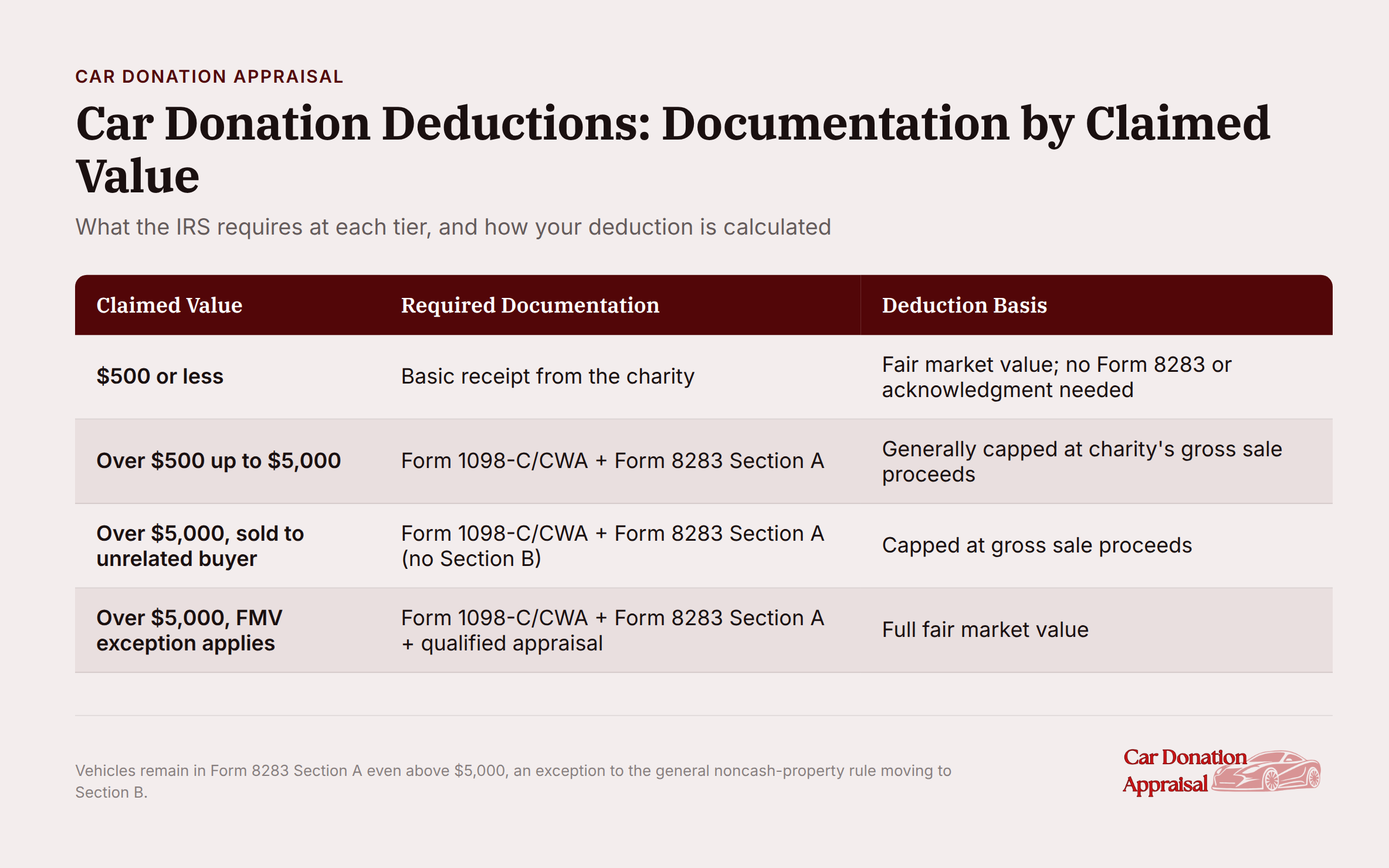
The paperwork you need scales with the deduction amount, and the rules shift at $500 and again at $5,000. The table below summarizes what applies at each tier.
| Claimed Value | Required Documentation | Deduction Basis |
|---|---|---|
| $500 or less | Basic receipt from the charity | Fair market value; no Form 8283 or acknowledgment required |
| Over $500, up to $5,000 | Form 1098-C/CWA, Form 8283 Section A | Generally capped at the charity's gross sale proceeds |
| Over $5,000, charity sells to an unrelated buyer | Form 1098-C/CWA, Form 8283 Section A (no Section B, despite the value) | Capped at gross sale proceeds |
| Over $5,000, charity certifies significant use, material improvement, or a qualifying below-market transfer | Form 1098-C/CWA, Form 8283 Section A, qualified appraisal | Full fair market value |
Notice that vehicles stay in Section A of Form 8283 even above $5,000, which is an exception to the general rule that noncash property over that threshold moves to Section B and triggers the full qualified-appraisal requirement for every item. The vehicle-specific rules in the Form 8283 instructions carve this out separately.
The Gross Proceeds Cap vs. the Fair Market Value Exception
When a charity simply sells a donated car to an unrelated buyer, the donor's deduction is generally capped at the gross proceeds from that sale, not the vehicle's retail or private-party value. This rule exists because most donated vehicles get sold quickly at auction for far less than guidebook value, and Congress wanted the deduction tied to what the charity actually realized.
There are three recognized exceptions that let a donor claim fair market value instead, as described in IRS guidance on qualified vehicle donations:
- The charity makes significant intervening use of the vehicle in its regular operations before selling or disposing of it.
- The charity makes a material improvement to the vehicle, meaning more than minor repairs or cleaning.
- The charity gives or sells the vehicle at a significantly below-market price to a needy individual, in direct furtherance of its charitable purpose.
If none of these apply, the acknowledgment should state the gross sale proceeds, and that figure becomes the deduction ceiling regardless of what an online valuation guide says the car was worth. Our breakdown of why a car donation deduction is often limited to the sale price covers this cap in more detail, including how to read the acknowledgment correctly.
Watch out: Claiming a guidebook value when the charity actually sold the car for less is one of the fastest ways to trigger a correspondence audit. The IRS can compare the acknowledgment's sale proceeds directly against the deduction claimed on Schedule A.
When a Qualified Appraisal Is Still Required
A qualified appraisal is required when the charity certifies one of the exceptions above and you are claiming fair market value above $5,000, such as a classic or collector vehicle the charity keeps and uses in its programs. The appraisal must be completed by a qualified appraiser no earlier than 60 days before the contribution date and no later than the due date (including extensions) of the return claiming the deduction, per IRS Publication 561.
A compliant appraisal needs to do more than state a number. It must identify the specific vehicle, the valuation date and method used, the specific facts supporting that value, and the appraiser's qualifications, with a signed declaration. Appraisers working in this space typically hold credentials through the Certified Appraisers Guild of America, the American Society of Appraisers, or follow standards set by The Appraisal Foundation under USPAP, and a report built to those standards is far more likely to hold up if the IRS asks questions.
How the IRS Reviews a Donated Vehicle's Value
The IRS does not take an appraisal or acknowledgment at face value just because it's attached to the return. During a review, the agency may contact the taxpayer directly for additional records, refer the valuation to an IRS valuation specialist, or, for higher-value items, route the file to internal specialists who scrutinize the appraiser's methodology and conclusions. This is standard practice for any noncash charitable deduction of meaningful size, and vehicles are no exception.
What Happens if a Required Document Is Missing
Not every missing document is fatal, but some are. If Form 8283 itself was never completed or was left incomplete, the IRS may allow the taxpayer to cure the defect by showing reasonable cause and the absence of willful neglect, often by supplying the missing information during the examination.
A missing contemporaneous written acknowledgment or a missing (or non-qualified) appraisal is a different problem. Both are independent, statutory requirements, and the IRS generally will not allow a taxpayer to obtain either one after the audit has already begun. If the charity never issued a 1098-C, or the appraisal wasn't performed within the required window, the deduction is at serious risk of outright disallowance.
How to Respond to an IRS Notice Questioning Your Deduction
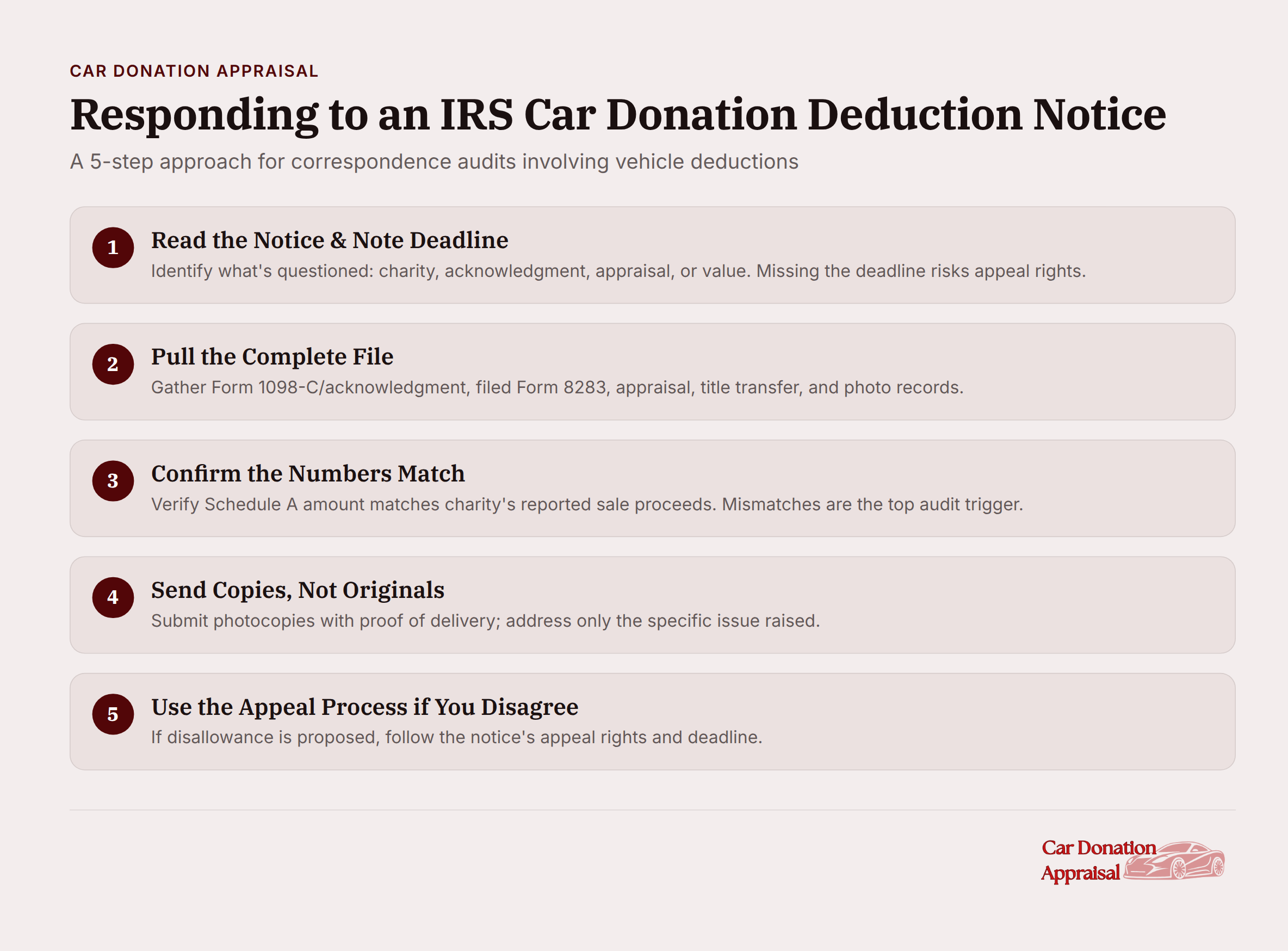
If a notice arrives questioning a car donation, respond methodically rather than reactively. The following sequence covers most correspondence audits involving a vehicle deduction.
- Read the Notice Carefully and Note the Deadline
- Identify exactly what the IRS is questioning: the charity's eligibility, the acknowledgment, the appraisal, or the claimed value itself. The response deadline on the notice controls, and missing it can forfeit appeal rights.
- Pull the Complete File
- Gather the Form 1098-C or acknowledgment, the filed Form 8283, any appraisal, and the title transfer and photo records described earlier in this guide.
- Confirm the Numbers Match
- Check that the amount claimed on Schedule A matches the gross sale proceeds reported by the charity, unless a documented exception applies. A mismatch here is the single most common audit trigger.
- Send Copies, Not Originals
- Submit photocopies of every document and keep proof of delivery. Respond only to the specific issue raised; sending unrelated records can slow the review down.
- Use the Appeal Process if You Disagree
- If the IRS proposes disallowing the deduction and you believe the documentation supports it, the notice will outline administrative appeal rights and the applicable deadline for using them.
Accuracy-Related Penalties for Overstated Vehicle Values
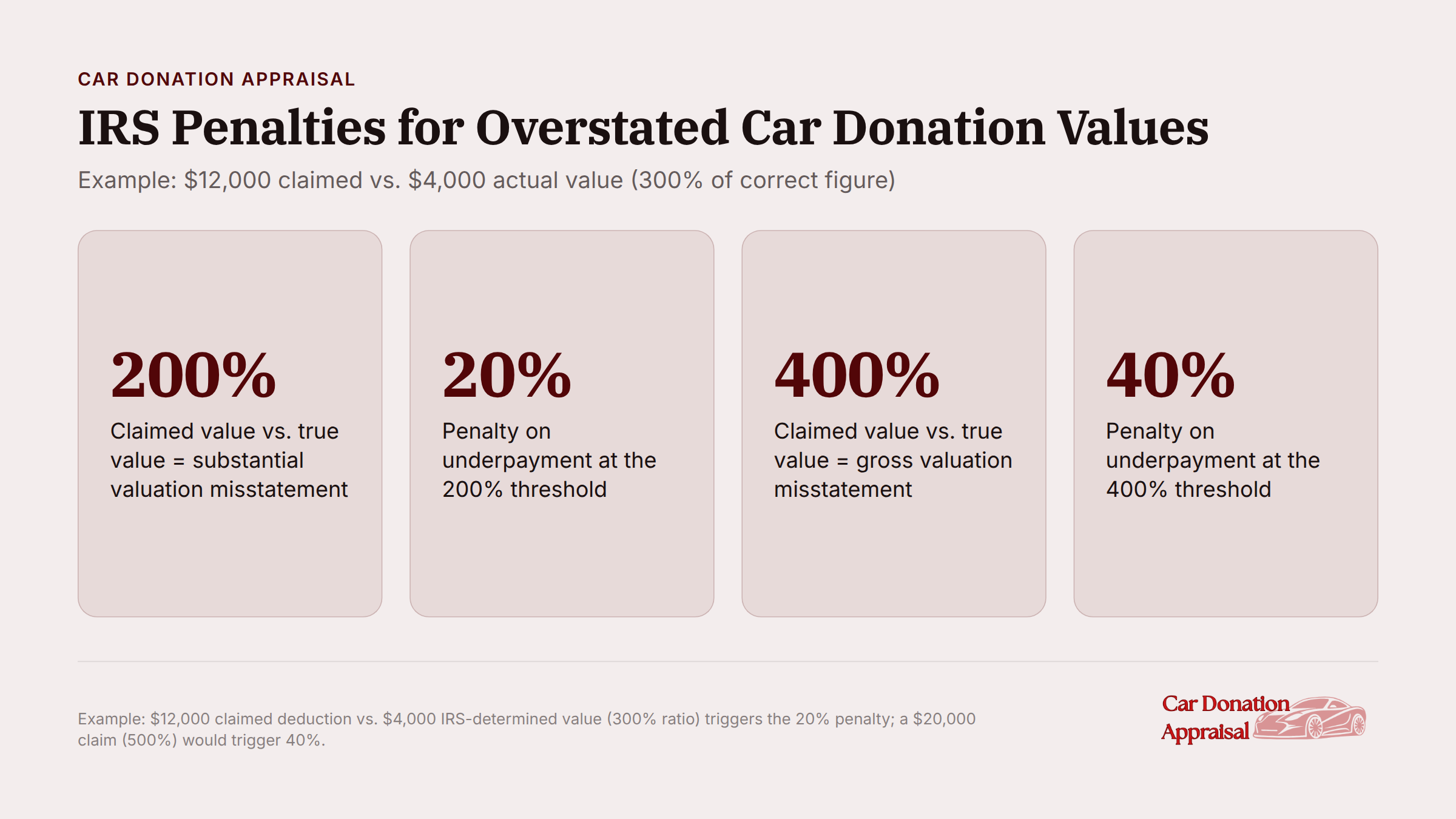
Overstating a donated vehicle's value doesn't just risk losing the deduction; it can trigger an accuracy-related penalty on top of the back taxes owed. Under the valuation-misstatement penalty rules, a claimed value that is at least 200% of the correct value counts as a substantial valuation misstatement and carries a 20% penalty on the resulting underpayment. A claimed value at least 400% of the correct value is a gross valuation misstatement, and the penalty doubles to 40%.
Example: A donor claims a $12,000 fair market value deduction for a classic car the charity certified it would keep and use. An IRS valuation specialist later determines the vehicle was actually worth $4,000 at the contribution date. That claimed value is 300% of the correct figure, which crosses the 200% substantial-misstatement threshold and exposes the donor to a 20% penalty on the resulting underpayment. Had the donor claimed $20,000 instead, the 500% ratio would push the penalty to 40%.
Keep the File Before You File, Not After
The single best defense against an IRS inquiry into a car donation deduction is building the file at the time of the gift rather than reconstructing it later. Keep the acknowledgment, the completed Form 8283, and any required appraisal together with the title and photos from day one, and most questions the IRS raises can be answered with a single, organized response.
If you're donating a vehicle the charity intends to keep and use rather than sell, and the claimed value will exceed $5,000, our Car Donation Appraisal team prepares USPAP-compliant reports built to withstand exactly this kind of review.
This article is provided for general informational purposes only and does not constitute legal, tax, or financial advice. Readers should consult a qualified attorney or CPA regarding their specific circumstances.