
Blog
Why Your Car Donation Deduction Is Often Limited to the Sale Price
If you donate a car worth more than $500, your tax deduction is usually capped at what the charity actually sold it for, not its Kelley Blue Book value. Here's the IRS rule behind that limit, the exceptions that let you claim fair market value instead, and when a professional appraisal actually matters.
Donors are often surprised to learn that the number on a Kelley Blue Book printout has almost nothing to do with what they can actually deduct. If you donate a used car and the charity turns around and sells it, federal tax law generally caps your deduction at the charity's gross sale proceeds, not the vehicle's fair market value (FMV) and certainly not its dealer retail price. This guide walks through the rule, the paperwork that enforces it, and the narrow exceptions that let you deduct FMV instead.
If you're weighing whether to donate your car at all, or you're trying to value a donated car before you hand over the keys, understanding this limitation first will save you from an unpleasant surprise at tax time.
The $500 Threshold That Triggers the Gross-Proceeds Rule
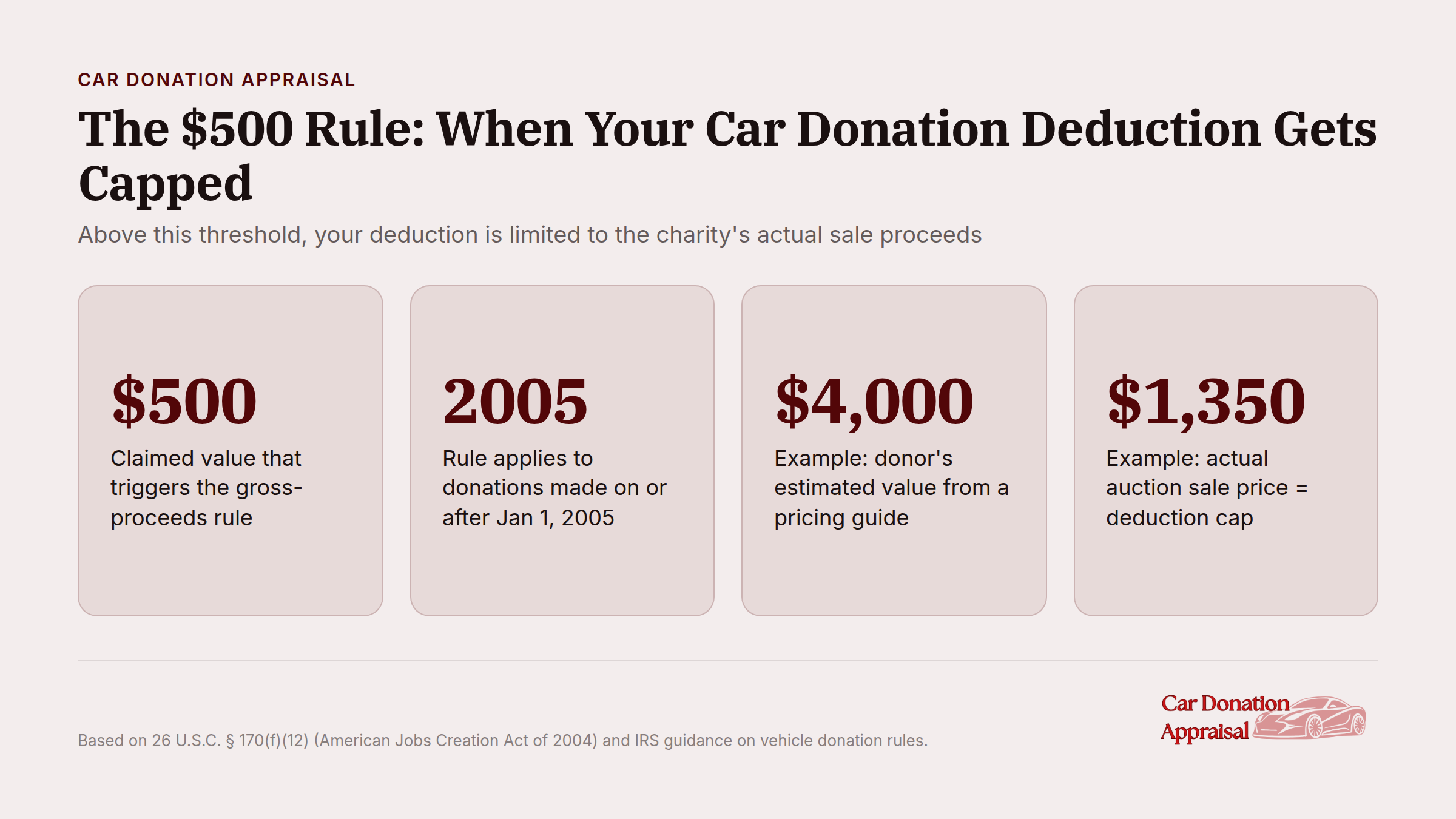
Once your claimed value for a donated vehicle exceeds $500, a special rule takes over and overrides the usual fair market value approach. Under the American Jobs Creation Act of 2004, codified at 26 U.S.C. § 170(f)(12), if a charity sells your donated vehicle without putting it to significant use or making a material improvement first, your deduction cannot exceed the gross proceeds from that sale.
The IRS guidance explaining the vehicle donation rules confirms this applies to donations made on or after January 1, 2005, and that the deduction is "generally limited to the actual sales price of the vehicle when sold by the donee charity." Below that $500 threshold, ordinary substantiation rules apply and you don't need to worry about this particular limitation.
Example: You donate a sedan you believe is worth $4,000 based on a private-party pricing guide. The charity sells it at auction for $1,350 and issues you a written statement showing that amount. Your deduction is capped at $1,350, regardless of what the guide said the car was worth.
Why Blue Book Value Isn't the Same as Tax-Deductible Fair Market Value
Pricing guides like Kelley Blue Book estimate what a car might sell for in a private-party or dealer retail transaction, assuming a knowledgeable, unpressured buyer and seller. That's a useful starting point for FMV, but it is not automatically the number the IRS lets you deduct.
Two things break the link between blue book value and your actual deduction:
- Condition adjustments. Dealer retail figures assume a vehicle in good condition. If your car needs brakes, has body damage, or has an odometer reading well above average, the applicable FMV is much closer to the private-party or trade-in figure, not the retail number. A used car in poor condition sold to a charity for parts or scrap is valued at what a similar buyer would actually pay, which is often a small fraction of the retail listing.
- The gross-proceeds override. Even when your FMV estimate is accurate, §170(f)(12) still caps your deduction at whatever the charity's sale actually brought in, once your claimed value tops $500. FMV only becomes the operative number again if one of the exceptions discussed below applies.
This is exactly the kind of mismatch the IRS has scrutinized in charitable contribution cases generally: donors who valued donated property using a market that wasn't realistically available to them, rather than the market that actually determined what a buyer would pay. The same logic applies to a used car. If nobody would pay dealer retail for your vehicle in its actual condition, that number was never really the deductible FMV to begin with.
Form 1098-C: The Document That Sets Your Deduction
You cannot claim a deduction over $500 for a donated vehicle without a proper written acknowledgment from the charity, and for most donations that acknowledgment is Form 1098-C. The charity is required to provide it to you within 30 days of the sale, and it must show the gross proceeds received.
IRS Publication 526 states plainly that for a qualified vehicle with a claimed value over $500, your deduction is the smaller of the gross proceeds from the sale or the vehicle's FMV on the date of the contribution. In practice, the gross proceeds figure on your Form 1098-C is almost always the number that governs, because it reflects what a real buyer actually paid in an arm's-length transaction.
The Form 1098-C instructions also make clear that if you don't attach this form, or an equivalent contemporaneous written acknowledgment, to your return, you cannot deduct the contribution at all. No form, no deduction, regardless of what the car was worth.
Watch out: Some donors assume a receipt from the charity showing a vague description like "1 vehicle" is enough. It isn't, once your claimed value passes $500. You need the specific gross-proceeds figure from Form 1098-C or a substantively equivalent written statement.
Three Exceptions That Let You Deduct Fair Market Value Instead
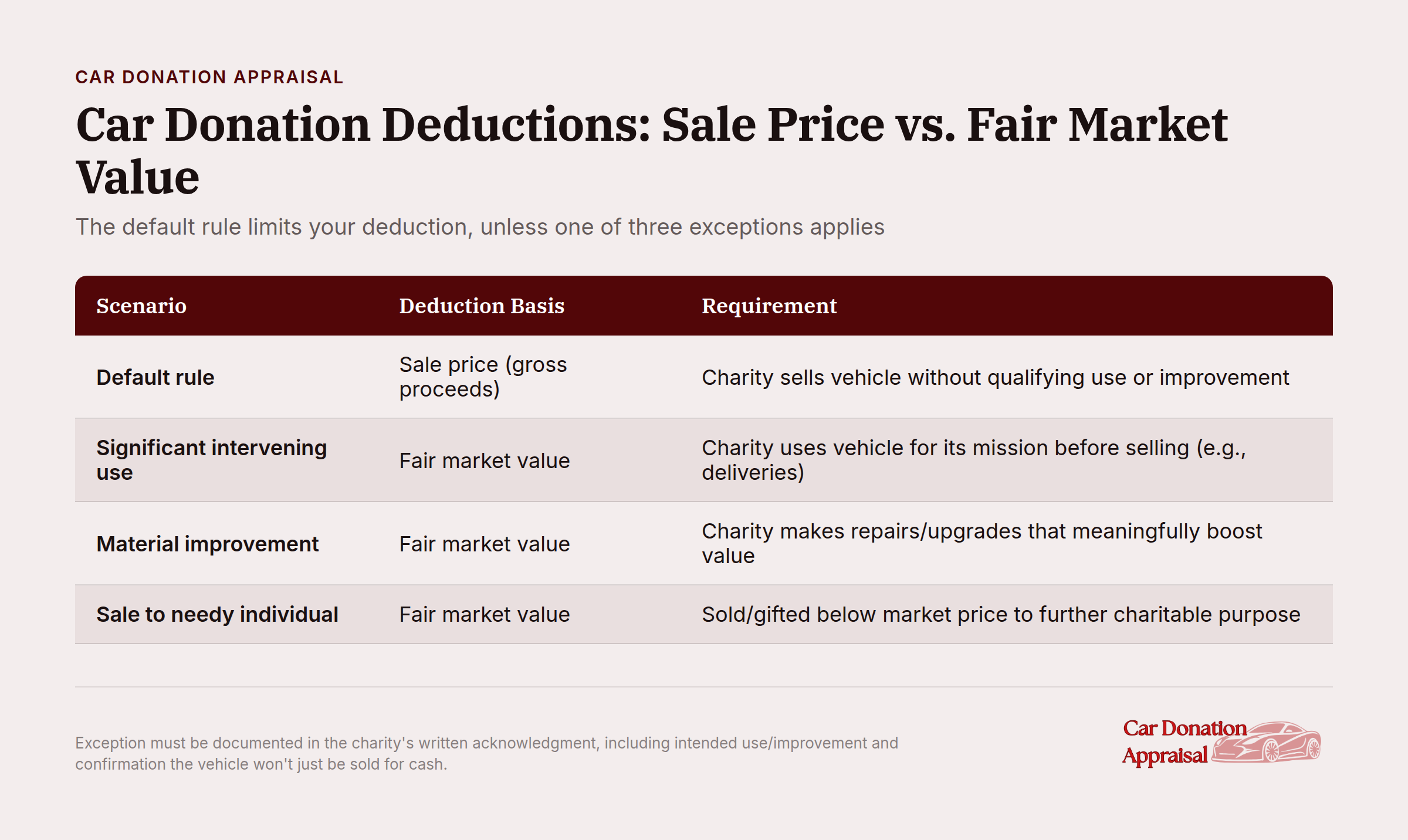
The gross-proceeds limitation is the default, but it isn't absolute. If one of three narrow exceptions applies, you can deduct the vehicle's FMV on the date of the gift rather than the eventual sale price.
- Significant intervening use by the charity. The organization uses the vehicle itself to further its mission, for example a food bank that drives the car to make deliveries for several months before selling it.
- Material improvement before sale. The charity makes repairs or upgrades that meaningfully increase the vehicle's value, beyond routine cleaning or minor maintenance.
- Sale or gift to a needy individual at a significantly below-market price. This applies when the transfer directly furthers the charity's charitable purpose of helping people with financial need, and the price charged is substantially below fair market value.
When an exception applies, the charity's written acknowledgment must say so and describe the intended use or improvement, along with a statement that the vehicle won't simply be sold for cash. Without that specific language from the charity, the default gross-proceeds rule still controls, even if you believe informally that the charity kept the car for a while before selling it.
When a Qualified Appraisal and Form 8283 Come Into Play
If your claimed vehicle value is $5,000 or more and one of the FMV exceptions genuinely applies, the stakes get higher. At that threshold, the IRS generally requires a qualified appraisal along with Section B of Form 8283, signed by both you and the appraiser, submitted with your return. This mirrors the broader qualified appraisal requirements that apply to noncash charitable donations across asset categories, which we cover in more detail in our guide to Form 8283 for car donations.
This is a fairly rare situation for a used passenger vehicle. It typically comes up with higher-value vehicles such as classic cars, low-mileage specialty vehicles, or fleet donations where a charity genuinely intends to use or improve the vehicle rather than immediately resell it. A qualified appraisal in this context should be prepared in accordance with USPAP and document the vehicle's condition, comparable sales, and the specific market in which it would realistically be sold, not a generic retail listing.
What This Means Before You Donate
Most donors giving an ordinary used car to a charity that resells it should expect their deduction to track the eventual sale price, not the number a pricing guide generated at home. That's not a loophole or a penalty; it's how Congress structured the rule after finding that donors were routinely overstating vehicle values relative to what charities actually received at sale.
If you're donating a higher-value vehicle, believe an exception may apply, or simply want a defensible, documented FMV figure before you hand over the title, our car donation appraisal service prepares valuations built around the vehicle's actual condition and the market it would realistically sell into. That documentation matters most when a qualified appraisal is genuinely required, and it gives you a clear-eyed number before you commit to a donation.
A car donation can still be a smart move for the right vehicle and the right charity. Just go in expecting the sale-price rule to govern the math, and keep the paperwork organized so you're not scrambling for it in April.
This article is provided for general informational purposes only and does not constitute legal, tax, or financial advice. Readers should consult a qualified attorney or CPA regarding their specific circumstances.