
Blog
Form 8283 for Car Donations: What It Is and When You Actually Need One
Form 8283 governs how you report a donated car to the IRS, and the vehicle rules inside it work differently from every other kind of noncash gift. This guide breaks down the $500 and $5,000 thresholds, Section A versus Section B, and when a qualified appraisal is actually required.
A donated car can turn into a denied deduction fast if the paperwork doesn't match what the IRS expects. Form 8283 is the document that reports noncash charitable contributions, and vehicles get a set of rules inside that form that don't apply to donated furniture or clothing. Here's what the form actually requires, when you need it, and where donors most often go wrong.
What Is Form 8283, and Why Are Vehicles Different?
Form 8283, Noncash Charitable Contributions, is the IRS form individuals and businesses attach to their return once their total noncash charitable deductions for the year exceed $500. Donated cars fall into a specific category the IRS calls "qualified vehicles," a group that also includes boats and airplanes, and that category carries its own substantiation rules layered on top of the standard Form 8283 instructions.
The reason vehicles get special treatment traces back to Internal Revenue Code Section 170(f)(12). Before that provision existed, donors regularly claimed inflated fair market values for cars that charities turned around and sold for a fraction of the claimed amount. Congress closed that gap by tying most vehicle deductions to what the charity actually receives from the sale, not what a donor thinks the car is worth. If you're weighing whether to donate a car at all versus selling it or trading it in, that distinction is worth understanding before you file anything.
The $500 Threshold That Triggers Form 8283
Form 8283 is required once your total noncash charitable deductions for the year exceed $500, not just when a single item crosses that line. The About Form 8283 page states plainly that individuals, partnerships, and corporations file the form when the amount of their deduction for all noncash gifts is more than $500.
For a car donation specifically, this means two things have to both be true before Form 8283 becomes optional:
- Your total noncash deductions for the year, including the car, add up to $500 or less.
- You have no other noncash gifts pushing you over that combined threshold.
In practice, almost every car donation clears $500 in claimed value, so most donors end up filing Form 8283 regardless of what else they donated that year. The question that actually matters for a car donation isn't whether you file the form, it's which section of the form you fill out.
Section A vs Section B: Why Most Car Donations Stay in Section A
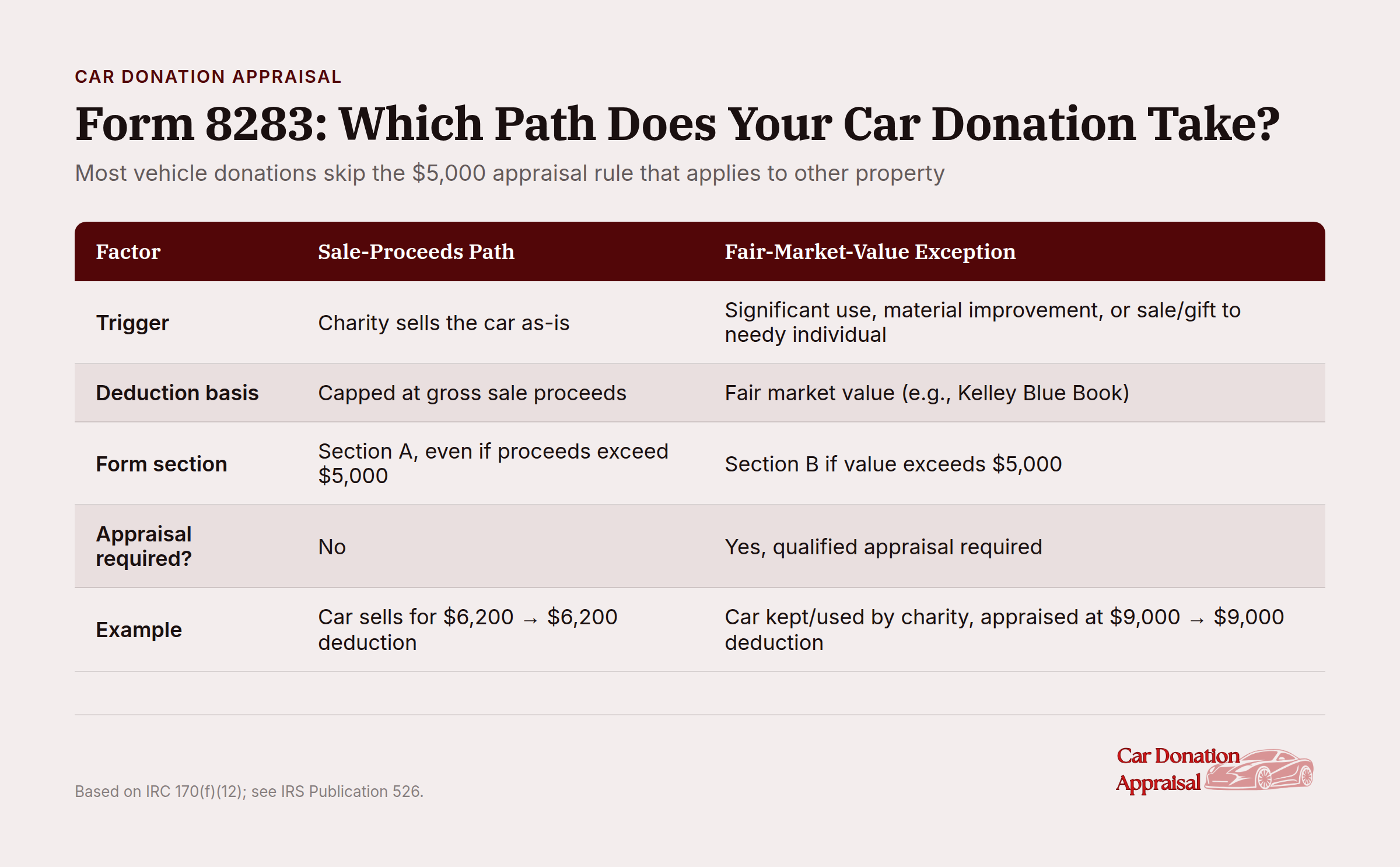
Form 8283 splits into two sections, and the split usually comes down to dollar value everywhere except vehicles. Section A covers property valued at $5,000 or less; Section B covers property valued above $5,000 and generally requires a qualified appraisal. Cars break that pattern.
Under IRC 170(f)(12), when a charity sells a donated vehicle without significant use or improvement, your deduction is capped at the gross proceeds from that sale, not the car's fair market value. That means a car a charity sells for $6,200 produces a $6,200 deduction even if a Kelley Blue Book estimate would have put the car's private-party value at $9,000. Because the deduction is tied to the sale price rather than an appraised value, most vehicle donations stay in Section A even when the sale proceeds exceed $5,000, and no appraisal is required at all.
This is the single most misunderstood rule in vehicle donation tax reporting. Donors assume that crossing $5,000 automatically means Section B and an appraisal. For a car the charity simply sells, it doesn't.
The Narrow Exceptions That Let You Claim Fair Market Value
The gross-proceeds cap has three exceptions, and only these three let you claim the car's fair market value instead of the sale price. IRS Publication 526 and the Form 8283 instructions describe them as situations where the charity does one of the following:
- Uses the vehicle significantly in its regular operations before selling or disposing of it, such as a food bank using a donated van for deliveries.
- Materially improves the vehicle through major repairs that increase its value, rather than performing minor repairs or cleaning.
- Sells or gives the vehicle to a needy individual at a price significantly below fair market value, or gives it away outright, as part of the charity's mission to help low-income individuals get transportation.
If your donation genuinely fits one of these three exceptions, you can deduct the car's fair market value rather than the charity's eventual sale price. That's the trigger point where Section B and a qualified appraisal come back into play, which we cover below.
Form 1098-C: The Charity's 30-Day Acknowledgment
For any qualified vehicle with a claimed value over $500, you cannot claim a deduction without a contemporaneous written acknowledgment (CWA) from the donee organization, and the charity generally satisfies that requirement with Form 1098-C. The About Form 1098-C guidance confirms the charity must furnish this acknowledgment to the donor, and it must be provided within 30 days of the sale or, if the charity keeps and uses the vehicle, within 30 days of the contribution.
A valid Form 1098-C must include:
- The donor's name and taxpayer identification number.
- The vehicle identification number (VIN).
- A statement of whether the charity sold the vehicle in an arm's length transaction to an unrelated party, and if so, the gross proceeds from that sale.
- A statement addressing whether any goods or services were provided in exchange for the vehicle.
- If the vehicle wasn't sold, a statement describing the charity's intended use or material improvement, and its intended duration of that use.
You attach this form, or an equivalent CWA, directly to Form 8283. Without it, the IRS instructions are unambiguous: no deduction, regardless of the car's actual value.
When You Actually Need a Qualified Written Appraisal
A qualified written appraisal is required only when you're claiming fair market value under one of the three exceptions above and that claimed value exceeds $5,000. Routine donations where the charity simply sells the car, capping your deduction at gross proceeds, never require an appraisal, no matter how high the sale price runs.
When an appraisal is required, Form 8283's Section B has to be completed and signed by both a qualified appraiser and an authorized official of the donee organization. The IRS is specific about what "qualified" means here: the appraiser needs relevant credentials and experience valuing the type of property involved, and the appraisal itself has to follow generally accepted appraisal standards.
This is where a written vehicle appraisal service earns its fee. If you believe your donated vehicle qualifies for the significant-use, material-improvement, or needy-individual exception and the fair market value is likely to exceed $5,000, having a car donation appraisal completed before you file protects the deduction if the IRS ever asks questions. Our appraisers document condition, mileage, comparable sales, and market data in a report built to satisfy Section B, with credentials recognized by organizations such as CAGA and standards consistent with USPAP. Vehicle appraisal fees start at $195 for a standard report and $295 for an IRS-qualified report, quoted as a fixed fee once we understand the vehicle and the intended use; typical vehicle appraisal engagements run $195 to $495 depending on documentation and complexity. You can request an appraisal once you've confirmed which exception applies to your situation.
Key Thresholds to Remember
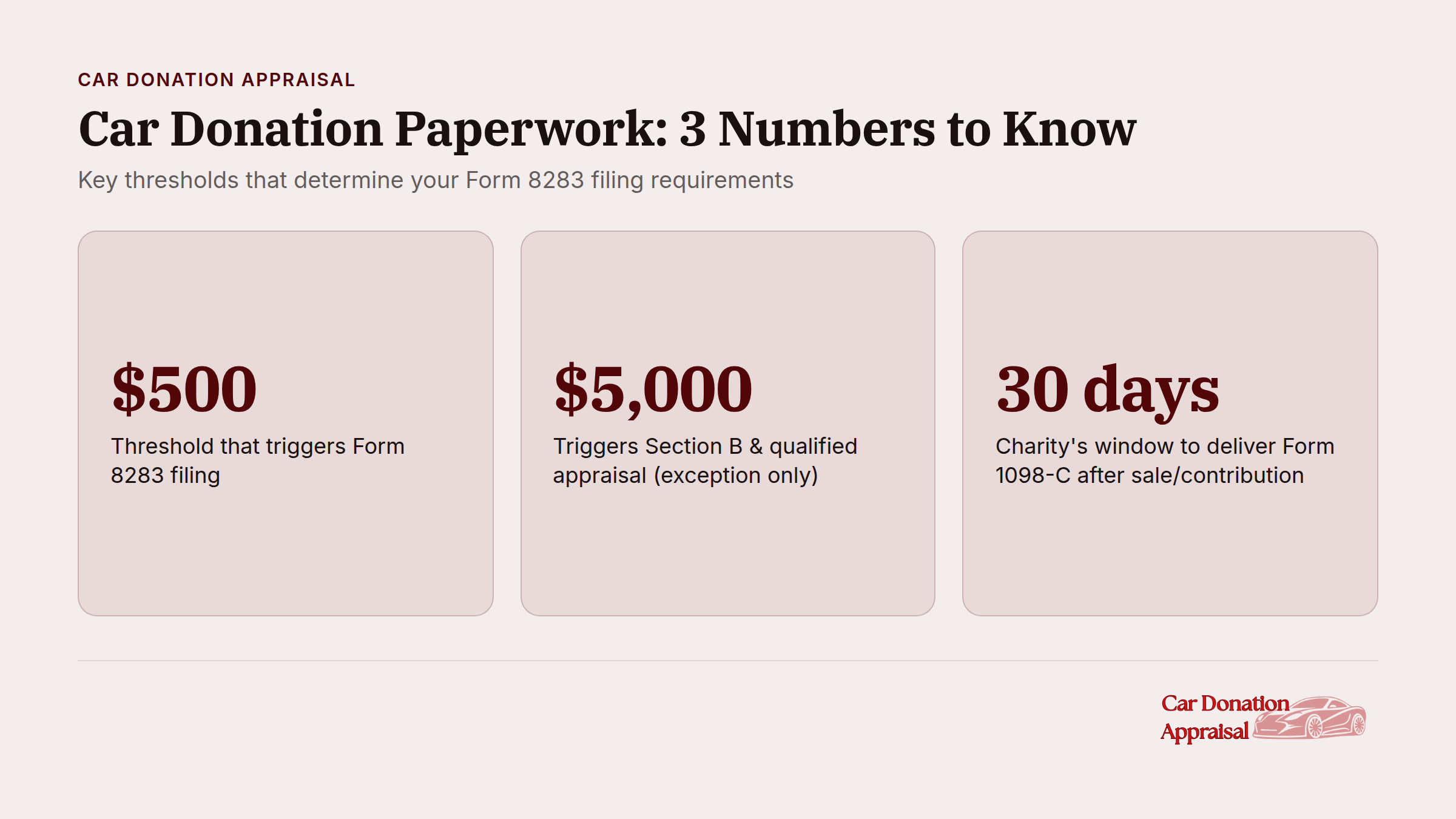
Three numbers govern nearly every car donation filing decision: the $500 mark that triggers Form 8283 at all, the $5,000 mark that triggers Section B and a qualified appraisal (but only under an exception), and the 30-day window the charity has to deliver Form 1098-C after the sale or contribution.
Common Mistakes That Get Vehicle Donation Deductions Disallowed
Most denied vehicle donation deductions trace back to one of a handful of avoidable errors. Watch for these specifically:
- Missing or late Form 1098-C. If the charity never sends the acknowledgment, or sends it after you've already filed, you have no documentation to attach to Form 8283 and the deduction is at risk.
- Claiming Kelley Blue Book "excellent condition" value. Donated cars are rarely in excellent condition, and the IRS routinely disallows deductions built on a condition tier the vehicle didn't actually meet. Fair market value has to reflect the car's actual condition at the time of donation, not a best-case guide estimate.
- Failing to attach Section B when an exception applies. If your charity kept and used the vehicle or sold it to a needy individual below market value, but you filed only Section A without the required appraisal and signatures, the deduction can be denied on a technicality even if the underlying value claim was reasonable.
- No qualified appraiser signature when one is required. A self-prepared value estimate, a dealer trade-in quote, or an online valuation tool doesn't satisfy the appraisal requirement once you're over $5,000 under an exception. Section B needs an actual appraiser's signature and credentials.
Watch out: Donors sometimes assume that because their car sold for a modest amount, no paperwork is needed at all. Even a $600 sale still requires Form 8283 and a Form 1098-C if your total noncash deductions for the year cross $500.
Getting the Paperwork Right Before You File
The vehicle rules inside Form 8283 exist to prevent inflated claims, but they also give honest donors a clear path to a defensible deduction. Know which of the two paths applies to your donation, the gross-proceeds path or the fair-market-value exception, before you estimate a number. If you land in the exception category above $5,000, get a professional read on the car's value and a signed appraisal in hand well before your filing deadline, since a qualified appraisal generally has to be received before the due date of the return claiming the deduction.
This article is provided for general informational purposes only and does not constitute legal, tax, or financial advice. Readers should consult a qualified attorney or CPA regarding their specific circumstances.