
Blog
Where to Donate My Car: Salvation Army vs. Goodwill vs. Kars4Kids Compared
Salvation Army, Goodwill, and Kars4Kids all accept car donations, but they process them very differently and keep very different shares of the sale price. This guide compares how each program works and explains the IRS paperwork, including when a qualified appraisal is required, so you can decide where to donate your car with your eyes open.
Choosing where to donate your car involves more than picking the charity with the catchiest jingle. Salvation Army, Goodwill, and Kars4Kids each run car donation programs, but they use different intake methods, different proceeds structures, and different levels of local control. If your vehicle is a classic, antique, or otherwise valuable car, our Car Donation Appraisal team can help you document the deduction correctly once you know where the car is headed.
This guide compares how each program actually works, explains why the percentage of proceeds a charity keeps matters more than its brand name, and covers the IRS paperwork tied to the donation, including when a qualified vehicle appraisal becomes a legal requirement rather than a nice-to-have.
How Salvation Army, Goodwill, and Kars4Kids Actually Handle Your Car Donation
All three organizations will take your car, but the machinery behind the donation differs a lot.
Salvation Army runs its vehicle donation intake through a centralized online portal where you enter your vehicle information and schedule a pickup. Salvation Army's own donation page notes that vehicle acceptance depends on location and local regulations, so not every type of vehicle is accepted at every center, and donors are directed to check with their local program before assuming a pickup will happen. In many markets, that intake is handled by a third-party vehicle donation processor rather than the local Salvation Army corps itself.
Goodwill is not one national car donation program at all. Goodwill is a federation of independent local affiliates, and whether a given Goodwill accepts vehicle donations, and how it processes them, depends entirely on that local organization. Consumer discussions on forums such as Reddit reflect this patchwork: some local Goodwill affiliates run their own car donation arm, while others don't accept vehicles at all or route donors to a partner processor.
Kars4Kids operates its own large-scale donation program rather than leaning on a third party. Its donation page states it can accept almost any vehicle regardless of condition, often even without a title, and it typically arranges pickup within 24 hours of the donor's call or online request.
Watch out: A charity's name recognition tells you nothing about who actually processes the sale. A well-known name can still route your car through a for-profit vehicle donation processor that keeps the majority of the proceeds.
Comparing the Three Car Donation Programs
The table below summarizes how each program is typically structured, based on how each organization describes its own process.
| Program | How It Works | Typical Proceeds Structure | Best For |
|---|---|---|---|
| Salvation Army | Centralized intake portal; acceptance and pickup vary by local center and regulations | Often processed through a third-party vehicle donation service | Donors who want a recognized national brand and don't mind local variability |
| Goodwill | No single national program; each local affiliate sets its own policy | Varies widely; some affiliates run donations in-house, others use outside processors | Donors who are willing to call their specific local Goodwill and ask directly |
| Kars4Kids | Runs its own large-scale donation program; online or phone intake, fast pickup | Program is operated directly by the charity rather than an outside broker | Donors who want a straightforward, fast process with one point of contact |
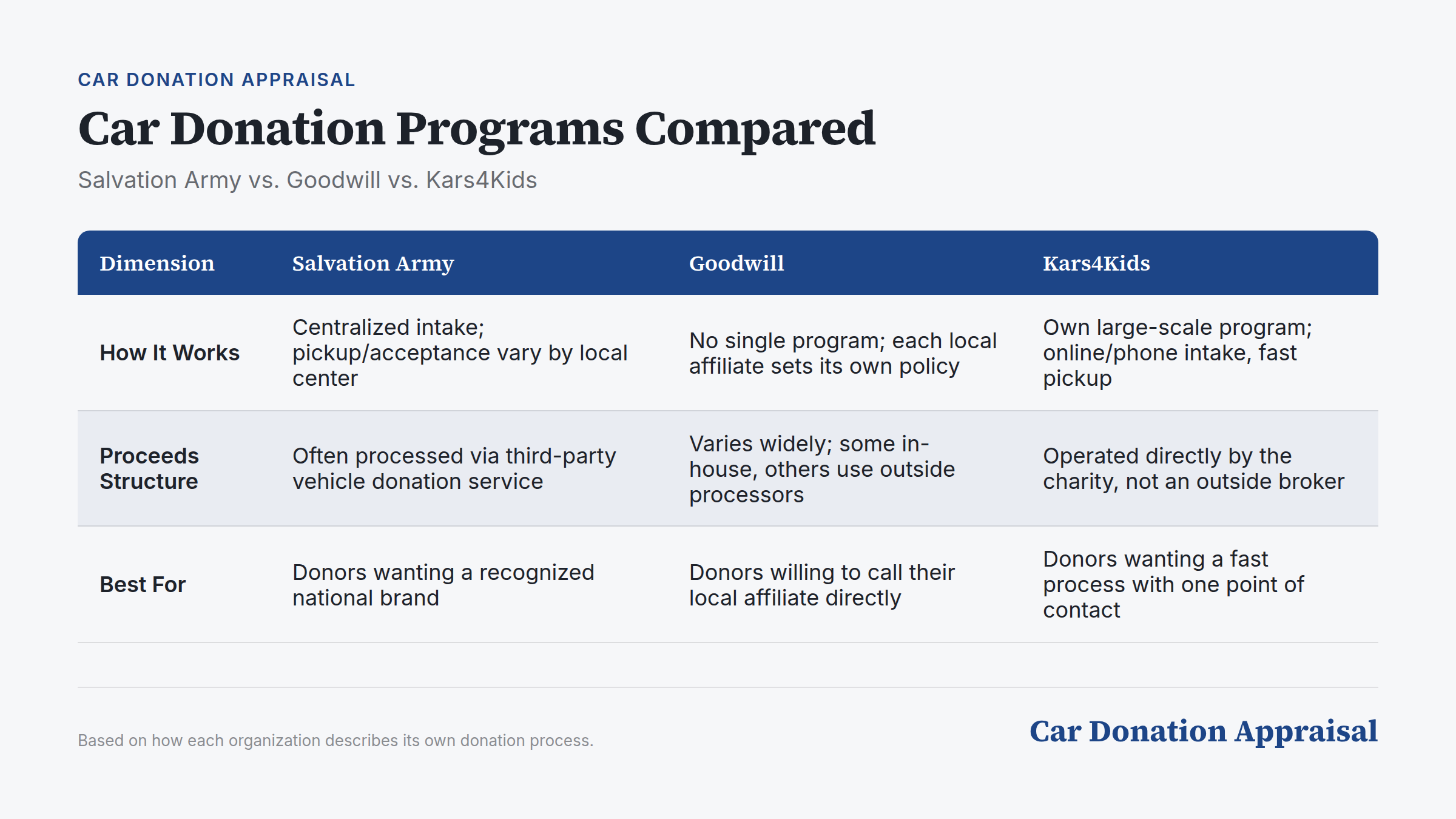
The chart below lays out these same differences at a glance, so you can compare intake method, proceeds structure, and best-fit donor side by side.
Why the Percentage of Proceeds Matters More Than the Charity's Name
The single most important question for anyone weighing where to donate a car is not brand reputation. It's how much of the sale price actually reaches the mission.
Charities that outsource car donations to a third-party broker or processor typically net somewhere in the range of 15% to 35% of the gross sale proceeds, since the processor's towing, auction, and administrative fees come off the top before the charity sees a dollar. Charities that run their own donation program directly, handling intake, title transfer, and sale themselves, typically net a much larger share, often in the range of 60% to 80% of gross proceeds. Neither structure is illegal or hidden; it's simply a difference in overhead.
Pro tip: Before you donate, call the specific chapter or program and ask what percentage of the sale price it actually keeps. A local Salvation Army corps or Goodwill affiliate that runs donations in-house can often tell you this number directly, and a program like Kars4Kids that operates its own process can typically speak to its overhead structure as well. If a representative can't or won't answer the question, treat that as useful information in itself.
Key takeaway: The charity's name doesn't determine how much of your donation reaches the cause. The processing structure does, and that's worth one phone call before you hand over the keys.
What the IRS Requires When You Donate a Car
The IRS ties your deduction to what actually happens to the vehicle after you hand it over, not to what you think the car is worth.
When a charity sells a donated vehicle to an unrelated buyer for more than $500, the charity is required to issue Form 1098-C, and your deduction is generally capped at the vehicle's gross sale proceeds, even if you believed the car was worth more. This is true regardless of which of the three programs above processes the sale. The IRS also requires you to itemize deductions on Schedule A to claim any car donation; if you take the standard deduction, the donation produces no tax benefit.
Example: You donate a 12-year-old sedan you believe is worth $3,000 based on a used car guide. The charity sells it at auction for $1,100. Your deduction is limited to $1,100, the gross sale proceeds, and the charity must send you Form 1098-C reflecting that amount.
There are two situations where the gross-proceeds cap doesn't apply and a higher deduction is possible:
- The charity keeps the vehicle and uses it in its own operations (a delivery van for a food bank, for instance) rather than selling it.
- The charity sells the vehicle at a price significantly below fair market value to a needy individual in furtherance of its charitable purpose.
In either case, if the claimed value of the vehicle is $5,000 or more, the IRS requires a qualified appraisal and Form 8283, Section B, signed by both the appraiser and an authorized official of the charity. A used car price guide or online estimate does not satisfy this requirement once you're past the $5,000 threshold and the vehicle isn't simply being sold for gross proceeds. For more detail on where these value thresholds come from, see how to value a donated car.
When a Qualified Vehicle Appraisal Is Required for Your Donation
Most car donations never trigger an appraisal requirement, because most donated vehicles are sold quickly at auction for modest amounts and the deduction is simply the sale price on Form 1098-C. A qualified appraisal becomes necessary in a narrower set of cases.
You'll typically need one when any of the following applies:
- The charity plans to keep and use the vehicle itself rather than sell it, and the claimed value is $5,000 or more.
- The vehicle is a classic, antique, or otherwise collectible car whose fair market value is likely to be claimed at $5,000 or higher.
- The vehicle has been significantly modified, restored, or is otherwise unusual enough that a standard used-car pricing guide won't capture its actual market value.
Our appraisers hold credentials with organizations such as CAGA and ASA, and every vehicle appraisal is prepared in accordance with USPAP so the report can support Form 8283, Section B. Auto appraisals through our team start at $195 for a standard report and $295 for an IRS-qualified appraisal, with most engagements running $195 to $495 depending on the vehicle's complexity and documentation. Highly complex vehicles, such as rare classics or heavily customized cars, typically run $1,800 to $4,500 or more. Every engagement is quoted as a fixed fee once we understand the scope, never billed by the hour.
If you believe your donation may fall into one of these categories, it's worth requesting a car donation appraisal before the vehicle changes hands, since the appraisal generally needs to reflect the vehicle's condition at the time of the contribution.
How to Choose Where to Donate Your Car
The right answer depends less on which of the three names sounds most familiar and more on what you actually want out of the donation.
- If convenience and speed matter most: a program that runs its own large-scale intake, like Kars4Kids, may offer the fastest, most predictable pickup process.
- If supporting a specific local mission matters most: call your local Salvation Army corps or Goodwill affiliate directly and ask whether they process vehicle donations in-house or through an outside service.
- If maximizing the charitable share of the sale matters most: ask every program you're considering what percentage of gross proceeds it actually nets, and choose accordingly.
- If the vehicle is valuable, unusual, or being kept by the charity rather than sold: confirm the $5,000 appraisal threshold applies to your situation and arrange a qualified appraisal before you donate.
None of this requires guessing. A five-minute phone call to the charity, and a quick check of the vehicle's likely value, will tell you almost everything you need to know before you sign over the title.
Whatever program you choose, keep your paperwork. Save the written acknowledgment from the charity, any Form 1098-C you receive after the sale, and, if your vehicle required one, the qualified appraisal and Form 8283. If you're unsure whether your donation crosses the $5,000 threshold or whether the charity intends to keep and use the vehicle, our team can help you sort out whether an appraisal is actually required before you make the call.
This article is provided for general informational purposes only and does not constitute legal, tax, or financial advice. Readers should consult a qualified attorney or CPA regarding their specific circumstances.